I Read the GBrain Post. Here's What I Built Instead.
Garry Tan's GBrain post describes a real gap. Most people's accumulated knowledge sits inert in flat files, and building something that actually uses it means assembling your own pipeline. His answer is a builder's answer: a stack you construct yourself on OpenClaw and tune to your own setup.
I came at the same gap from the other end.
When I went independent and started consulting, the twenty years of notes behind me stopped being an archive and became the thing I was actually selling. Pattern recognition across engagements is what a client pays for, and I could not reliably get at my own. I've written about that before: more time spent hunting for old thinking than doing new thinking, on hours I could not bill.
So I went looking for something that would fix it, and nothing did the part that mattered. What I ended up with was duct tape. A script here, a local model there, whatever held long enough to answer the question in front of me that afternoon. It worked the way duct tape works, which is to say it worked until it didn't, and it never got better on its own. At some point last year I stopped patching and started putting the thing together properly.
That is roughly when Garry's post hit the wire.
Reading it was a strange experience. Someone had described my own project back to me, publicly, to an audience many times the size of mine.
What Garry's post gave me was a name. I had built the thing and still did not have good language for what it was, and he supplied that language in a form a lot of people understood immediately. It also confirmed I was not talking myself into a problem that only I had. That is not a small contribution and I am glad to say so plainly.
It does something useful for anyone weighing up Elicana, too. If you have read GBrain, you already know the architecture, so you do not have to take my word for what compiling your documents means or why it beats searching them. You can go and read the argument made by someone with no stake in my product, and then decide whether you want to build it or buy it.
The same move, aimed at different people
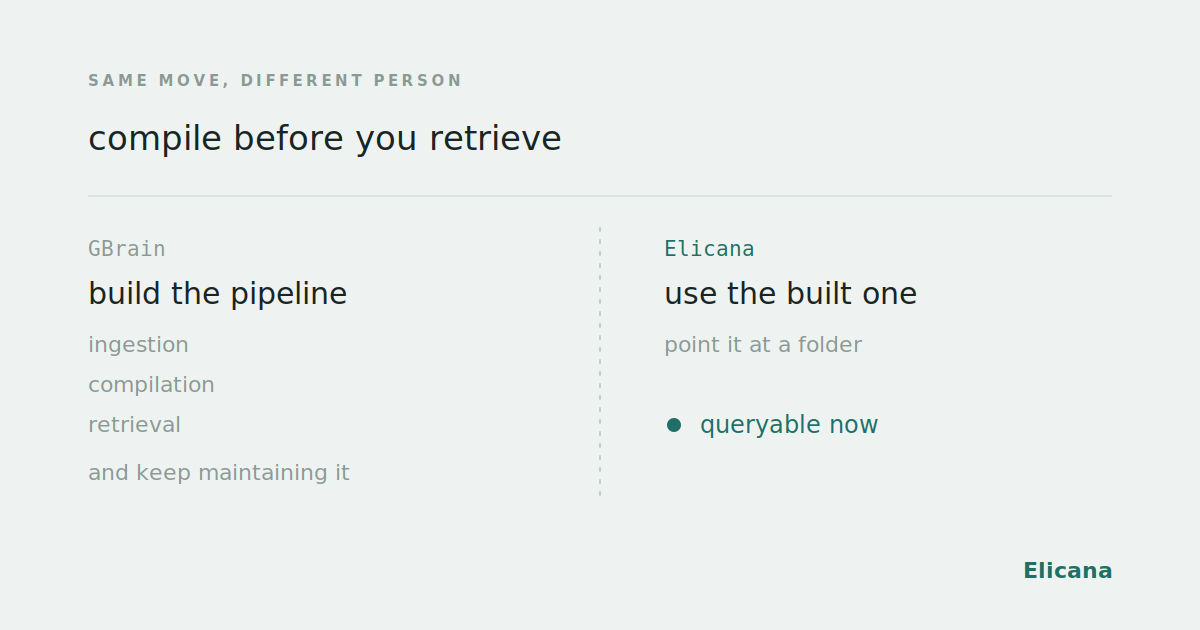
GBrain is a reference architecture. You assemble the ingestion, the compilation logic and the retrieval layer, and you keep maintaining all three as your corpus grows and your needs change. That is the right answer when building the system is part of what you wanted, or when the tinkering is the point. For a lot of developers it genuinely is.
Elicana takes the same underlying move, compile before you retrieve, and packages it. It is for the consultant, the researcher, the analyst who has years of accumulated documents and wants them queryable now rather than after a build project they did not ask for.
Neither replaces the other. GBrain proved the pattern works and gave it language the community now uses. Elicana is what you would want running if you decided the maintenance was never the part you were after.
Why the compile step is the whole argument
The reason both projects reach for compilation rather than better search is that search is not where the problem lives. Documents written over years drift: the same idea gets a different label in 2021 than it does in 2023, nobody is inconsistent on purpose, and every generation of enterprise search has broken on exactly that rock. Retrieval can only rank what is already there. If the labels disagree, so does the retrieval, no matter how good the ranking is.
Compilation attacks it from the other end. Normalize the material as it comes in, resolve the drift at the source, and the query stops having to guess which words past you happened to use.
GBrain and Elicana agree on that completely. We disagree only about who should have to build it.
One point worth being precise about, because it is the practical difference: Elicana does not require OpenClaw. I happen to run OpenClaw myself, but that is my setup, not a dependency of the product. GBrain asks you to get several separate pieces standing up and talking to each other, and then to keep them that way. Elicana is one thing you install and point at a folder. Nothing else has to be present, and nothing else has to keep working.
That is the whole difference in practice. Not a better idea, a shorter setup.
If you read the GBrain post and thought "I want this, I just don't want to build and maintain it," that is who Elicana is for.
Elicana is in open beta: no waitlist, no cohort. Get Elicana.