Why AI Tools Fail at Your Document Archive
Most AI document tools fail for a reason that has nothing to do with the model. It's not a search problem. It's a data quality problem, and no re-ranker or better embedding model fixes it, because the inconsistency lives upstream of retrieval.
What gets missed is that this is not a new problem. Organizations have been trying to make their accumulated documents searchable and usable for more than two decades, and every generation of technology has broken on the same rock.
The last time we tried this
In 2002 Google launched the Search Appliance, a rack-mounted box that promised to bring Google-quality search within a company, indexing intranets, file shares and email so employees could find what the organization already knew. It was discontinued in 2016. The hardware worked; the indexing worked; the search ranking worked. What did not work was the underlying assumption that enterprise data was clean enough to search.
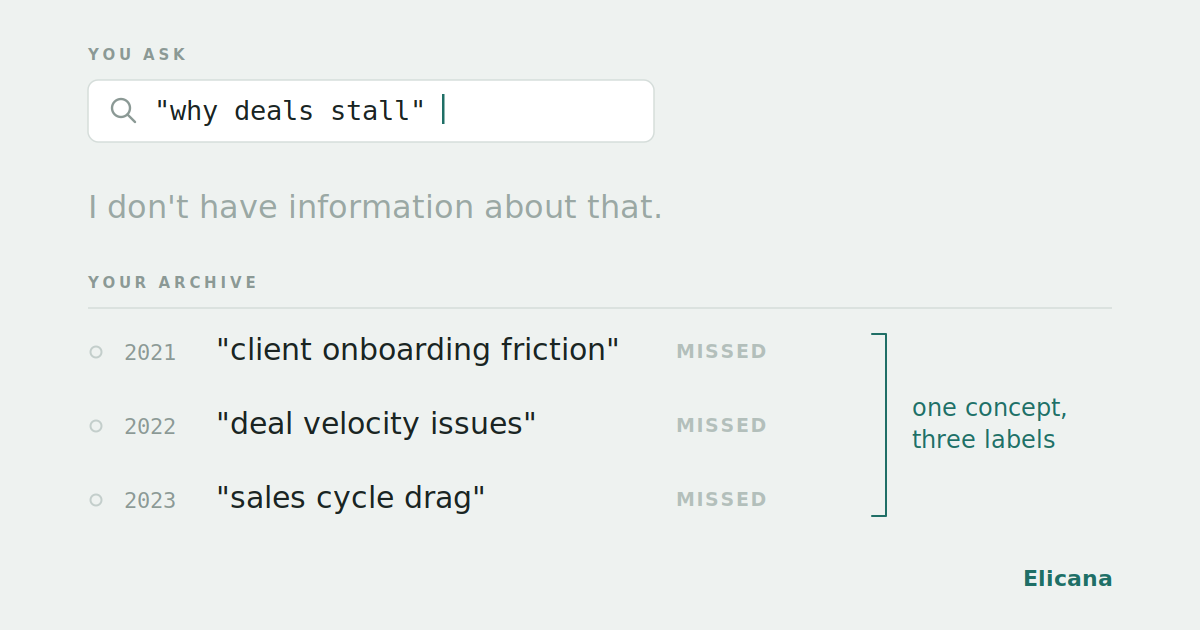
The same story played out across dozens of enterprise search products. The technology was never the bottleneck. The bottleneck was the data: years of documents written by different people, at different times, for different audiences, using different words for the same thing. A search engine cannot resolve what "client onboarding friction" in 2021, "deal velocity issues" in 2022 and "sales cycle drag" in 2023 all refer to. It can only index what is there. If the labels are inconsistent, the retrieval is inconsistent, no matter how good the algorithm.
Why the data is inherently "dirty"
The phrase "dirty data" usually means typos, duplicates and missing fields. That is not what breaks document archives. The deeper problem is semantic inconsistency accumulated over time.
Someone who has collected notes, docs, clippings, etc., over say five years has a rich data set. The language in the first year's notes reflects what the user knew then. By year five the same concepts have been renamed, reframed and absorbed into a richer vocabulary. The 2021 notes are not wrong; they are just written in a dialect the 2025 version of the author no longer uses.
This is unavoidable. It is the natural result of learning. It is also invisible until you try to search across the whole corpus and discover that your own older documents are written in a language you have partly forgotten.
The remedies that failed
The industry recognized this early and threw multiple fixes at it: taxonomies, controlled vocabularies, metadata standards, records-management programs, data-governance initiatives that demanded every document be tagged at creation with the "correct" labels, etc.
None of them stuck, for a single shared reason: they required discipline at write time from people whose job is not filing. A consultant writing a note at 11pm after a client call is not going to pause and consult the corporate taxonomy. A researcher capturing a half-formed insight is not going to validate it against a controlled vocabulary. The governance programs failed because they asked humans to be consistent, and humans learning over time are by definition not consistent.
The current casualty: RAG and chat-with-your-docs
Two decades later, the same rock is breaking the newest ships. RAG tools, NotebookLM and the wave of "chat with your documents" products all chunk your files, embed them and retrieve by similarity. The technology is far more sophisticated than the Google Search Appliance was but the data problem is identical.
When you ask a RAG system a question, it retrieves the chunks whose embeddings are closest to your query. If your 2023 documents say "sales cycle drag" and you search "why deals stall", those documents are not close in embedding space and as a result the tool tells you it does not know. The older your knowledge base gets, the worse this compounds. Vocabulary drift accumulates while the document count keeps growing, so a three-year archive is often less searchable than a one-year archive.
The failure looks like an AI limitation. It is not. It is a data-normalization limitation that every previous generation of search technology also failed to solve.
The fix is not better search
It is compilation: transforming raw documents into structured, normalized artifacts before you index them, resolving the vocabulary inconsistency at the source. Map your 2021 words and your 2023 words to the same underlying concept, so a query for either one finds both. Normalize at ingestion rather than demanding consistency from the author.
That is what Elicana does. It compiles your vault, resolves the vocabulary drift and builds a normalized index. Queries return what you meant, not just what you happened to type the day you wrote the document.
Elicana is in open beta: no waitlist, no cohort. Get Elicana.